
Note: This post is part of a series about burnout recovery and why, despite the efforts to follow the research on how to recover from burnout, we can still burnout again. This series was initially delivered as part of a presentation I did here in Utah and aligns with my coaching and speaking work.
When I first went through burnout I knew the road to recovery would be long. From everything I read it sounded like a situation where the months, to years, of chronic stress would take equally long, or longer, to build the right habits and practices to effectively work through and reset. I also read that leaving your workplace was not a guarantee that you’d not be burned out in the next job. Part of the reason for that was if you never set boundaries, committed to too much, or never asked for help if you didn’t resolve those things you’d likely recreate the conditions for burnout in your next role too.
For me, I can look back and see where with every new job I’d work to add tools and tactics to better protect me from stress and burnout but over time a life of people pleasing, perfectionism, and overthinking combined with the fear of ongoing layoffs, constant leadership and strategy changes, and a lack of direct leadership support for an extended period led to complete burnout for me.

When I went back to work after my initial burnout break I knew it wasn’t going to be magic and rainbows. Many of the things that contributed to my burnout were still present but as is the case for most folks quitting my job and not working wasn’t an option. I committed to coming back and doing my best in the hopes that things could get better.
Let’s pause from my personal story for a moment to review the concept of burnout as a cycle. What I have discovered is that for many women the ways we show up at work, often influenced by societal expectations and pressures, can be both what makes women successful and what can lead them to burnout. The Resilience Trap happens when you repeat the cycle over and over without solving for how you will show up in a different way.
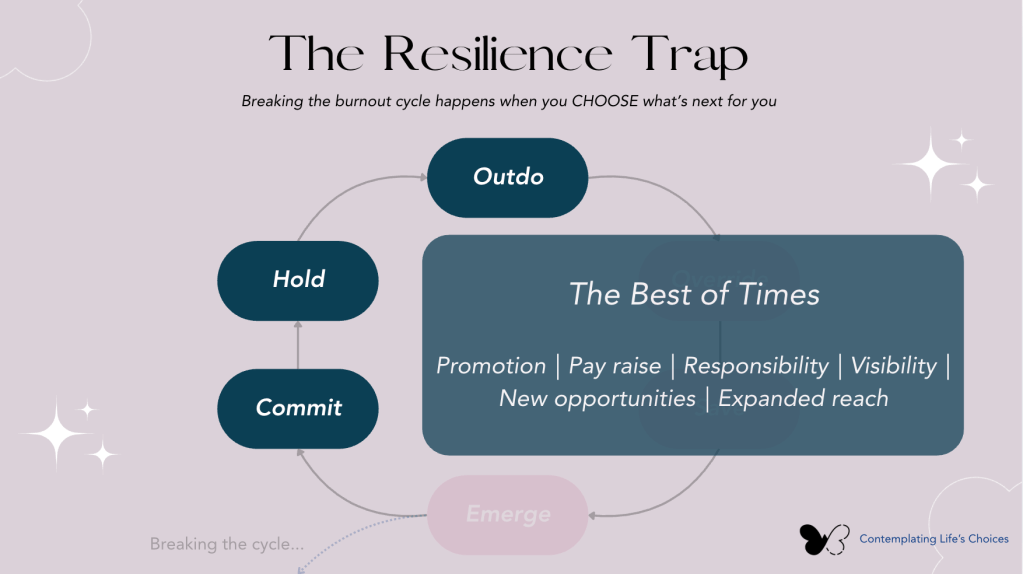
The burnout cycle looks like this:
- Commit: you are excited for that new job, new promotion, or new opportunity. You’re all in and even if there is some impostor syndrome or doubt you are excited for the future. There can be a values alignment with your role where you feel a sense of purpose in what you’re doing.
- Hold: you start to pick up and hold all the responsibilities and the work of your role. You say yes to assignments, volunteer to help out peers or other teams, and you build the relationships you need to succeed. You’re in it to win it and solving problems building strong initial credibility and confidence.
- Outdo: you build on the basics of your job often expanding your reach into new opportunities and responsibilities. You lean in joining employee resource groups, leading committees, and picking up the extra work that can show your commitment and capabilities. You can sometimes be put into the space of being told if you want the promotion you’ll do the things now to show you are ready for that next step.
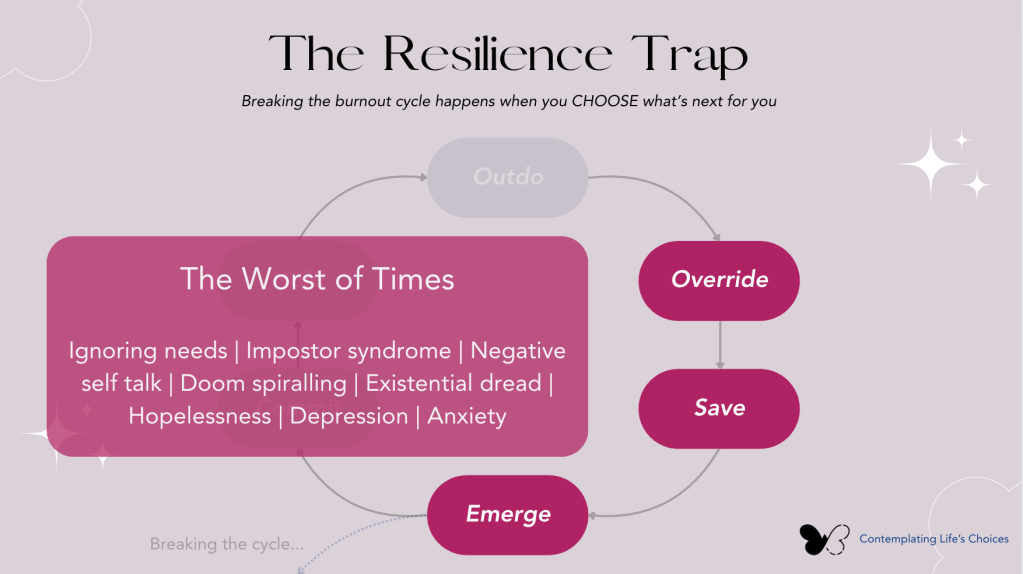
- Override: maybe you’re starting to get stressed. The responsibilities are piling up and months to years of saying yes to all the things you realize you’re holding too much. You look at the job market, changes in the economy, and AI hype and figure better to stay with the devil you know and make the best of a bad situation. You tell yourself you can self-care your way through things or that it could be just as bad elsewhere so why leave.
- Save: one day you crash out, maybe you get really sick, or you finally get a bad performance review or negative feedback. You decide it’s time to do something different or to change so you invest in therapy, get a coach, take some time off, or start reading all the books about burnout, anxiety, and time management. You decide to fully participate in saving yourself from the chronic stress in whatever form that looks like for you.
- Emerge: you emerge from your saving activities potentially with stronger boundaries, the ability to ask for and receive help, and you decide you’re going to assume positive intent and move forward. You know you’ll stop saying yes to everything so you can create space for what matters and you decide to recommit to your role knowing that you either have to make things better here or find yourself enough time to get into something else.
If you’re like me, and many of the women I’ve coached and mentored, this cycle will be very familiar. Sometimes we run through this cycle in small ways where a long weekend or a little self care helps us through and we’re back into the cycle on Monday morning. Other times, you hit the wall and have the break down and crash out moment where the save motion takes more effort and professional support.
One thing I want people to see is the first three parts of the cycle (Choose, Hold, and Outdo) can be the things that get you raises, promotions, new opportunities, higher visibility, and expanded reach. The first part of the cycle are the things I see in every successful woman I know. They’re the ones you look at and say “wow she’s a superwoman” and “I can’t believe she does it all balancing kids, family, community, AND work”.
The other noteworthy point about this cycle is the last three parts (Override, Save, and Emerge) can be where we build bad habits, mental models, or behaviors that can continue the burnout cycle. This is where I see women ignoring their needs, being told to just keep leaning in, or falling deeper into impostor syndrome. Often this is where doomscrolling, existential dread, or apathy can take over leaving women battling depression, anxiety, or a health crisis.
The overlap with systemic challenges exists because women, at least here in the US where I am, are socialized to carry it all, to lean in harder, and to do the work of the next role up in hopes that when the promotion becomes available you’ll finally be seen and deemed “worthy”. We’re told to not be angry, not be emotional, not raise our voices, and not advocate for ourselves lest we be perceived as greedy or bossy. The same traits that are deemed “executive presence” in men are weaponized against women when they display them. Women are pushed by coaches, influencers, and media to “have it all” or they are told that they can’t have it all and that they’re failing as a mother if they work and failing as an employee if they are a mother. Add to our self imposed pressures the layers of things like return to office mandates that disproportionally impact women who are caregivers, generational expectations to not give up on that prestigious career, and a poor job market that makes leaving less of an option and it’s no wonder highly capable and competent women are burning out.

The Resilience Trap happens when we continue to believe that just one more time around the burnout cycle and we’ll get that promotion and feel worthy, that the next job will have the boss that will finally invest in us and help us grow, or that the extra work will pay off and we’ll finally be recognized for our contributions. The skills of adaptability, resilience, perseverance, conscientiousness, and emotional intelligence that make us indispensable in our roles can be the exact reasons why we don’t get promoted, why we work harder to not be a burden on others, or we dismiss our needs because “someone” has it harder than us. Every missed promotion, the meets expectations when it defensibly was an exceeds, or the work we pick up that allows someone else to not cary their work can add to a sense of hopelessness and burnout.
Join me in the next post where we’ll talk about breaking the burnout cycle.
If you are currently in burnout and feel you can’t go on you can call or text the Crisis Line at 988 24/7. If you are not in immediate crisis but want additional support you can call or look up your local 211 for free and confidential health and human services. If you are employed, I also recommend looking into your insurance or other benefits to see if you have free or discounted access to therapy, wellness, or self-care support.


Leave a Reply